Coregistering DEM data#
This notebook is avaiable on GitHub here.
Rigorous DEM differencing necessitates coregistering scenes. pdemtools includes a couple of functions to make this quick and easy. A simple method of coregistration is provided, that of Nuth and Kääb (2011), with functions to correct your DEM against either a reference surface or ICESat-2 data. The Nuth and Kääb method accounts for translation errors only (i.e. x, y, and z offsets). For further options (e.g. rotation or tilt), it is worth
consulting the xdem package for more in-depth options.
As usual, we will import pdemtools, in addition to the in-built os function for file management and matplotlib to plot our results in this notebook.
[1]:
import os

import pdemtools as pdt

import matplotlib.pyplot as plt

plt.rcParams['figure.constrained_layout.use'] = True
plt.rcParams['font.sans-serif'] = "Arial"
We will also need to provide the local location of the Greenland BedMachine product. It does not need to be in any specific directory - just provide the complete filepath as a string.
[2]:
bm_fpath = "/Users/tom/Library/CloudStorage/OneDrive-DurhamUniversity/data/bedmachine_5/BedMachineGreenland-v5.nc"
Getting strips#
We will once again grab some ArcticDEM strips to assess elevation change. This time, let’s take a look at a subglacial lake drainage beneath Isunguata Sermia in West Greenland (Livingstone et al., 2019). We will take two strips across a drainage event, coregistering them against each other using stable ground, and then using the ICESat-2 method.
[3]:
bounds = -235000, -2499000, -222000, -2487000
We will exammine a drainage that took place in August 2019:
[4]:
%%time

gdf = pdt.search(
    dataset='arcticdem',
    bounds = bounds,
    years = 2019,
    months = [6,7,8],
    baseline_max_hours = 24,
    sensors=['WV03', 'WV02', 'WV01'],
    accuracy=2,
    min_aoi_frac = 0.6,
)

if gdf is not None:
    print(f'{len(gdf)} strips found')
3 strips found
CPU times: user 65.4 ms, sys: 9.13 ms, total: 74.5 ms
Wall time: 1.14 s
[5]:
gdf
[5]:
| geometry | gsd | title | created | license | rmse | proj:code | published | is_lsf | proj:shape | ... | href_hillshade | href_hillshade_masked | pdt_id | pdt_datetime1 | pdt_datetime2 | pdt_dem_baseline_hours | pdt_datetime_mean | pdt_year | pdt_month | pdt_aoi_frac | |
|---|---|---|---|---|---|---|---|---|---|---|---|---|---|---|---|---|---|---|---|---|---|
| 0 | POLYGON Z ((-233128 -2497824 0, -232352 -24891... | 2.0 | SETSM_s2s041_WV03_20190616_104001004D3CFC00_10... | 2021-11-07T07:06:20Z | CC-BY-4.0 | -9999 | EPSG:3413 | 2022-09-22T06:12:13Z | True | [6208, 7559] | ... | https://pgc-opendata-dems.s3.us-west-2.amazona... | https://pgc-opendata-dems.s3.us-west-2.amazona... | SETSM_s2s041_WV03_20190616_104001004D3CFC00_10... | 2019-06-16 15:20:00+00:00 | 2019-06-16 15:21:02+00:00 | 0.0 | 2019-06-16 15:20:31+00:00 | 2019 | 6 | 0.738371 |
| 1 | POLYGON Z ((-232856 -2498972 0, -232848 -24988... | 2.0 | SETSM_s2s041_WV03_20190811_104001005197F500_10... | 2021-11-07T06:57:17Z | CC-BY-4.0 | -9999 | EPSG:3413 | 2022-09-22T06:12:14Z | True | [6317, 7343] | ... | https://pgc-opendata-dems.s3.us-west-2.amazona... | https://pgc-opendata-dems.s3.us-west-2.amazona... | SETSM_s2s041_WV03_20190811_104001005197F500_10... | 2019-08-11 15:09:51+00:00 | 2019-08-11 15:10:42+00:00 | 0.0 | 2019-08-11 15:10:16.500000+00:00 | 2019 | 8 | 0.698926 |
| 2 | POLYGON Z ((-234446 -2487778 0, -234372.298 -2... | 2.0 | SETSM_s2s041_WV01_20190825_102001008C7F9500_10... | 2021-11-07T07:03:56Z | CC-BY-4.0 | -9999 | EPSG:3413 | 2022-09-22T06:12:06Z | True | [58747, 14836] | ... | https://pgc-opendata-dems.s3.us-west-2.amazona... | https://pgc-opendata-dems.s3.us-west-2.amazona... | SETSM_s2s041_WV01_20190825_102001008C7F9500_10... | 2019-08-25 18:21:10+00:00 | 2019-08-25 18:21:59+00:00 | 0.0 | 2019-08-25 18:21:34.500000+00:00 | 2019 | 8 | 0.986516 |
3 rows × 51 columns
Elsewhere in these tutorials, we explored using the pdt.load.preview function to assess data quality, as well as downloading and saving scenes. We will skip previewing the scenes (spoilers: the two highest-quality strips are 2019-06-16 and 2019-08-25 at index 0 and 2), and compress our scene download into the following cell:
[6]:
selected_scenes = [0, 2]
gdf_sel = gdf.iloc[selected_scenes]

date_1 = gdf_sel.iloc[[0]].pdt_datetime1.dt.date.values[0]
dem_id_1 = gdf_sel.iloc[[0]].pdt_id.values[0]

date_2 = gdf_sel.iloc[[1]].pdt_datetime1.dt.date.values[0]
dem_id_2 = gdf_sel.iloc[[1]].pdt_id.values[0]

output_directory = 'example_data'

if not os.path.exists(output_directory):
    os.mkdir(output_directory)

def get_scene(gdf_row, dem_id, output_directory):
    # Download and save, or load from saved if already downloaded.
    out_fpath = os.path.join(output_directory, f'{dem_id}.tif')
    if not os.path.exists(out_fpath):
        dem = pdt.load.from_search(gdf_row, bounds=bounds, bitmask=True, pad=True).compute()
        dem.rio.to_raster(out_fpath, compress='ZSTD', predictor=3, zlevel=1)
    else:
        dem = pdt.load.from_fpath(out_fpath, bounds=bounds, pad=True)
    return dem

print('Getting DEM 1')
dem_1 = get_scene(gdf_sel.iloc[[0]], dem_id_1, output_directory)

print('Getting DEM 2')
dem_2 = get_scene(gdf_sel.iloc[[1]], dem_id_2, output_directory)

print('Retrieved')
Getting DEM 1
Getting DEM 2
Retrieved
Great, let’s quickly visualise these:
[7]:
fig, axes = plt.subplots(ncols=2, sharex=True, sharey=True, figsize=(8,3.4))

ax = axes[0]
dem_1.plot.imshow(ax=ax, cmap='gist_earth', vmin=0, vmax=800, add_colorbar=False)
ax.set_aspect('equal')
ax.set_title(date_1)

ax=axes[1]
dem_2.plot.imshow(ax=ax, cmap='gist_earth', vmin=0, vmax=800, cbar_kwargs={'label': 'Elevation [metres above ellipsoid]'})
ax.set_aspect('equal')
ax.set_ylabel(None)
ax.set_title(date_2)

plt.show()
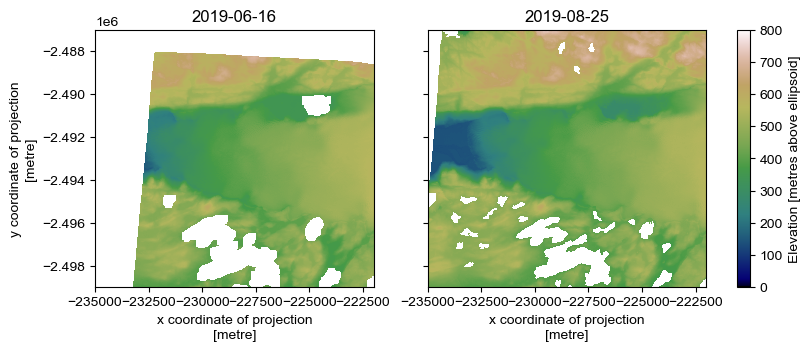
Note that these DEMs have some patches in them, but the important thing is that they’re good quality across the glacier, and there’s enough bare surface for coregistration!
No coregistration#
First, let’s do a simple dem difference based upon the non-coregistered strips:
[8]:
dz_no_coreg = dem_2 - dem_1
[9]:
fig, ax = plt.subplots()
vrange = 10  # metres

dz_no_coreg.plot.imshow(ax=ax, cmap='coolwarm_r', vmin=-vrange, vmax=vrange, cbar_kwargs={'label': 'Elevation Change [m]'})

ax.set_title(f'{date_2} - {date_1} (no coregistration)')
ax.set_aspect('equal')

plt.show()
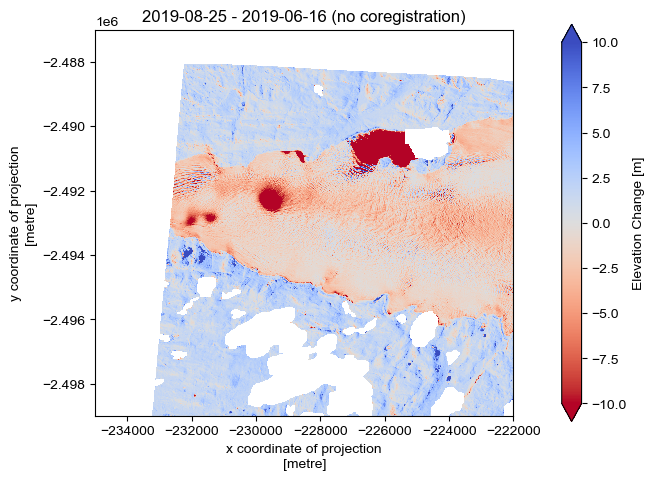
Because the changes are so large, it’s still possible to visualise some of the features here. However, it is very messy and there is a clear systematic negative trend across the stable bedrock. As a result, any surface change measurements will contain a systematic offset. This offset is what coregistration aims to fix.
Coregister based on stable ground#
Now, let’s coregister dem_2 against dem_1 using the stable bedrock.
The Nuth and Kääb (2011) method is based around the fact that the offset between two DEMs is possible to estimate based on simple measurements. The first is a slope-dependent offset: the measured dZ over stable ground will be larger over regions of steeper slopes. The second is an aspect-dependent offset: for a shift in a single direction, the lee and stoss slopes will experience different dZ values, allowing the direction and magnitude of the horizontal offset to measured. By reconstructing the dX, dY, and dZ values against a reference dataset, we can ‘coregister’ the DEM to the reference.
In the first form of this method provided by pdemtools, we will coregister the two DEMs against each other based on the stable (i.e. non-glacial) ground they share. First, we must set a region of stable ground to coregister too. Around Antarctica and Greenland, we can base this on the bedrock mask included within BedMachine. The data.bedrock_mask_from_bedmachine() function makes this easy, as we will pull the bedrock mask from BedMachine and do all the necessary behind-the-scenes
resampling:
[10]:
bedrock_mask = pdt.data.bedrock_mask_from_bedmachine(bm_fpath, dem_1)
Then we can coregister dem_2 against dem_1 using the .pdt.coregister() function. This is based on code used in the PGC postprocessing pipeline, updated to utilise the updated pdemtools geomorphometric variable derivation.
[11]:
dem_2_coreg_bedrock, metadata_coreg_bedrock = dem_2.pdt.coregister_dems(
    dem_1,
    stable_mask=bedrock_mask,
    return_stats=True,
)
Planimetric Correction Iteration 1
Offset (z,x,y): 0.000, 0.000, 0.000
RMSE = 2.4997572898864746
Planimetric Correction Iteration 2
Offset (z,x,y): 1.727, 6.646, 2.250
Translating: 1.73 Z, 6.65 X, 2.25 Y
RMSE = 1.3887134790420532
Planimetric Correction Iteration 3
Offset (z,x,y): 1.736, 6.280, 2.071
Translating: 1.74 Z, 6.28 X, 2.07 Y
RMSE = 1.3855750560760498
Planimetric Correction Iteration 4
Offset (z,x,y): 1.736, 6.309, 2.089
Translating: 1.74 Z, 6.31 X, 2.09 Y
RMSE = 1.3856514692306519
RMSE step in this iteration (0.00008) is above threshold (-0.001), stopping and returning values of prior iteration.
Final offset (z,x,y): 1.736, 6.280, 2.071
Final RMSE = 1.3855750560760498
In this example, we have set the return_stats variable to True. This additionally return a metadata dictionary, which will allow us to inspect the final offsets and errors. If the coregistration fails for whatever reason (or, in some exceptions, only able to perform a vertical, rather than vertical and horizontal, correction) it will be recorded in the coreg_status parameter as 'failed’ or 'dz_only’ rather than 'coregistered':
[12]:
metadata_coreg_bedrock
[12]:
{'coreg_status': 'coregistered',
 'x_offset': 6.2799902856349945,
 'y_offset': 2.0714651346206665,
 'z_offset': 1.7363408440724015,
 'x_offset_err': 0.0032978144966238207,
 'y_offset_err': 0.002309573488523257,
 'z_offset_err': 0.0005464694888281476,
 'rmse': 1.3855750560760498,
 'coregistration_type': 'reference_dem'}
Sometimes, if one of the DEMs is smaller than the clip region, this can fail. If this is the case, try ‘padding’ the DEMs with NaN values to the full AOI, e.g.:
dem = dem.rio.pad_box(*bounds, constant_values=np.nan)
This can be done automatically within load module functions by setting pad=True.
Let’s compare and plot:
[13]:
dz_coreg_bedrock = dem_2_coreg_bedrock - dem_1
[14]:
fig, ax = plt.subplots()
vrange = 10  # metres

dz_coreg_bedrock.plot.imshow(ax=ax, cmap='coolwarm_r', vmin=-vrange, vmax=vrange, cbar_kwargs={'label': 'Elevation Change [m]'})

ax.set_title(f'{date_2} - {date_1} (stable ground coreg)')
ax.set_aspect('equal')

plt.show()
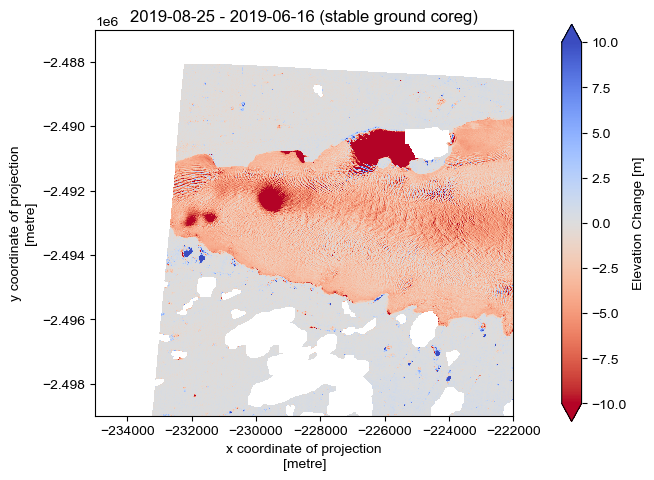
This is much better. There are still ‘spots’ of blunders across the stable ground (this is often associated with steep slopes or, in particular in this dataset, the freeze-over of ponds and lakes), but where the surface is stable between the two scenes the bias is very low. You can clearly see the three centres of negative surface elevation change on the glacier surface - these are the subglacial lakes that have drained - as well as something indicative of the drainage channel along the central flow axis. You can even see that the outburst flood has eroded a channel in the proglacial environment!
Coregistration based on ICESat-2#
This is all very well and good, but these sort of features and dynamics occur all across the ice sheet, and won’t always have some stable ground nearby for easy coregistration of ArcticDEM and REMA strips. Instead, ‘inland’ coregistration is often performed against satellite altimetry data.
Another option for coregistration is to use the same coregistration routine (Nuth and Kääb, 2011) but using ICESat-2 altimetry data as the reference surface. pdemtools contains a wrapper function that automates the download and processing of ICESat-2 data using sliderule (Shean et al. 2023). This section outlines how to use this function
to coregister ArcticDEM and REMA strip data.
⚠️ NOTE: ICESat-2 started collecting data from the 14th October 2018, so it will not be useful in coregistering contemporaneous ice surface data before this point. However, ICESat-2 of any age could be used to coregister against stable off-ice regions if desired (for instance, if ArcticDEM or REMA mosaics are unavaiable or of poor quality for your area of interest).
Download IS2#
The data module has an icesat2_atl06 function to enable easy download of suitable ICESat-2 over a given ArcticDEM or REMA strip. All you need to provide is the dem and the dem acquisition date.
ICESat-2 ATL06-SR is downloaded on the fly from sliderule using the ``sliderule` Python package <https://slideruleearth.io/web/rtd/user_guide/ICESat-2.html>`__. Compared to standard processed ATL06 data, we request a higher resolution - a step distance of 10 metres with an extent length of 20 metres ("res"=10, "len"=20; versus the default 20 m and 40 m respectively). This allows us to better compare with ArcticDEM/REMA data, which we will
downsample to 10 m for the coregistration process.
We will want to prioritise the ICESat-2 passes that are temporally closest in time. We first query all points within 7 days. If we can’t find a requisite number of points overlapping valid pixels (by default, 50), we go on to query 14, 28, and 45 days. One complete ICESat-2 global repeat is 90 days long, so we really shouldn’t need more than ±45 days. However, cloud is always a problem, so you can provide your own list of days to query through the days_r parameter is necessary. The geopandas
dataframe that is returns also includes a custom request_date_dt column, so you can filter and make your own decisions on what ICESat-2 point to pass to the coregistration routine.
[15]:
is2points_1 = pdt.data.icesat2_atl06(dem_1, date_1)
Querying points within 7 days... 32 points found with 15 intersecting dataset. Below minimum threshold (100). Expanding temporal search.
Querying points within 14 days... 32 points found with 15 intersecting dataset. Below minimum threshold (100). Expanding temporal search.
Querying points within 28 days... 305 points found with 141 intersecting dataset.
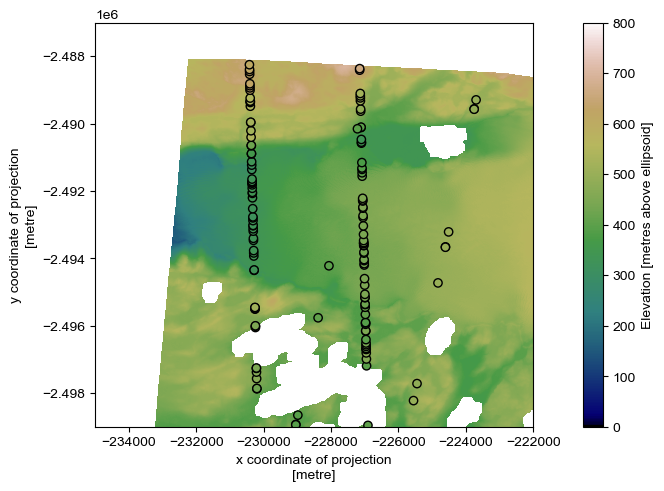
We can see what this looks like by plotting the ICESat-2 points over the DEM:
[16]:
fix, ax = plt.subplots()

dem_1.plot.imshow(ax=ax, cmap='gist_earth', vmin=0, vmax=800, cbar_kwargs={'label': 'Elevation [metres above ellipsoid]'})
is2points_1.plot(ax=ax, column='h_mean', cmap='gist_earth', vmin=0, vmax=800, ec='k', legend=False)
ax.set_title(None)

plt.show()
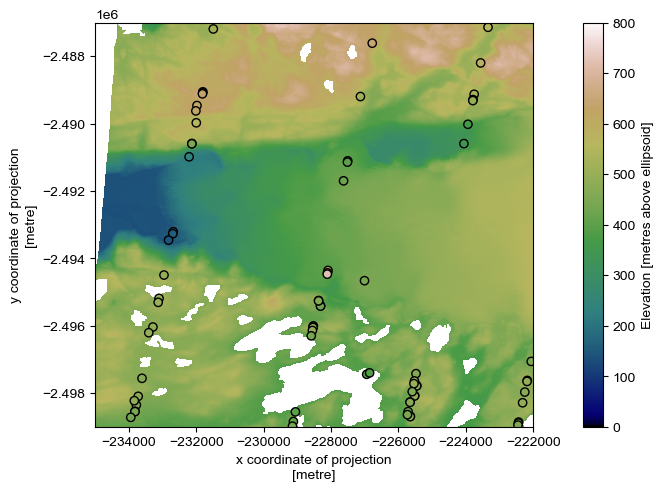
Let’s do the same for the second image:
[17]:
is2points_2 = pdt.data.icesat2_atl06(dem_2, date_2)
Querying points within 7 days... 10 points found with 4 intersecting dataset. Below minimum threshold (100). Expanding temporal search.
Querying points within 14 days... 38 points found with 29 intersecting dataset. Below minimum threshold (100). Expanding temporal search.
Querying points within 28 days... 99 points found with 77 intersecting dataset. Below minimum threshold (100). Expanding temporal search.
Querying points within 45 days... 99 points found with 77 intersecting dataset. Below minimum threshold (100).
/Users/tom/Library/CloudStorage/OneDrive-DurhamUniversity/scripts/tools/pdemtools/src/pdemtools/data.py:345: UserWarning: Returning GeoDataFrame with number of points below minimum threshold.
  warnings.warn(
Note that we receive a warning that we haven’t received the optimal number of points. An option in this situation could be to increase our temporal search range (e.g. add days_r = 90 to extend the search range to 90 days). This will allow us to collect more ICESat-2 data, but a greater date range will mean that the the ICESat-2 ice surface will be increasingly different to the DEM ice surface. We can further get around this by introducing a stable_mask parameter to the icesat2_atl06
function, if we have off-ice surface within our AOI. However, the whole point of this alternative method is to be able to explore regions away from stable ground.
As a result, for this example, we take the pragmatic choice: accept that the total number is still pretty close to the minimum threshold, and move forward with a slightly non-optimal point cloud.
[18]:
fix, ax = plt.subplots()

dem_2.plot.imshow(ax=ax, cmap='gist_earth', vmin=0, vmax=800, cbar_kwargs={'label': 'Elevation [metres above ellipsoid]'})
is2points_2.plot(ax=ax, column='h_mean', cmap='gist_earth', vmin=0, vmax=800, ec='k', legend=False)

ax.set_title(None)

plt.show()
Coregistration function#
Our ICESat-2 coregistration function pdt.coregister_is2() operates largely the same as the pdt.coregister_dem() function, accepting largely the same parameters (and in fact both are a wrapper for an underlying coregistration function using the same maths).
One major difference is that the step distance for our ATLO6-SR data is 10 m resolution, a lower resolution than the 2 m reference DEM data. The 2 m resolution is redundant and perhaps disadvantageous for coregistration. Therefore, if the input DEM is < 10 m, it will be resampled to 10 m during the coregistration routine (these numbers can be changed in the more detailed parameters). The output will still be at the native resolution, however.
As we’ve seen this before, let’s suppress the output using verbose=False.
[20]:
dem_1_coreg_is2, dem_1_coreg_is2_metadata = dem_1.pdt.coregister_is2(
    is2points_1,
    return_stats=True,
    verbose=False,
)
No `stable_mask` provided: assuming entire scene is suitable reference surface.
Upsampling 2.0 m DEM to 10 m resolution for coregistration process...
Final offset (z,x,y): -0.985, -1.628, -0.807
Final RMSE = 0.7749522310917916
Applying transform to original image...
Translating: -0.99 Z, -1.63 X, -0.81 Y
[21]:
dem_2_coreg_is2, dem_2_coreg_is2_metadata = dem_2.pdt.coregister_is2(
    is2points_2,
    return_stats=True,
    verbose=False,
)
No `stable_mask` provided: assuming entire scene is suitable reference surface.
Upsampling 2.0 m DEM to 10 m resolution for coregistration process...
Final offset (z,x,y): 0.997, 1.244, 0.436
Final RMSE = 1.3319617245141544
Applying transform to original image...
Translating: 1.00 Z, 1.24 X, 0.44 Y
Our new metadata countains three additional variables: points_n, the number of points used for coregistration; points_dt_days_max, the maximum number of days between the DEM and ICESat-2 dates; and points_dt_days_count, a dictionary where the keys represent the temporal offset from the DEM date in days, and the values represent the number of points that have that temporal offset.
[22]:
dem_2_coreg_is2_metadata
[22]:
{'coreg_status': 'coregistered',
 'x_offset': 1.2438564308904818,
 'y_offset': 0.4361289204786737,
 'z_offset': 0.9966485479070465,
 'x_offset_err': 2.056510690289901,
 'y_offset_err': 1.164318741484589,
 'z_offset_err': 0.23018213974842833,
 'rmse': 1.3319617245141544,
 'points_n': 76,
 'points_dt_days_max': 19,
 'points_dt_days_count': {19: 48, -10: 25, 1: 4},
 'coregistration_type': 'reference_icesat2'}
These additional matadata variables could be used for additional first-order QA of batch-processed output.
Let’s now plot our DEM difference:
[23]:
dz_coreg_is2 = dem_2_coreg_is2 - dem_1_coreg_is2
[24]:
fig, ax = plt.subplots()
vrange = 10 # metres

dz_coreg_is2.plot.imshow(ax=ax, cmap='coolwarm_r', vmin=-vrange, vmax=vrange, cbar_kwargs={'label': 'Elevation Change [m]'})

ax.set_title(f'{date_2} - {date_1} (ICESat-2 coreg)')
ax.set_aspect('equal')

plt.show()
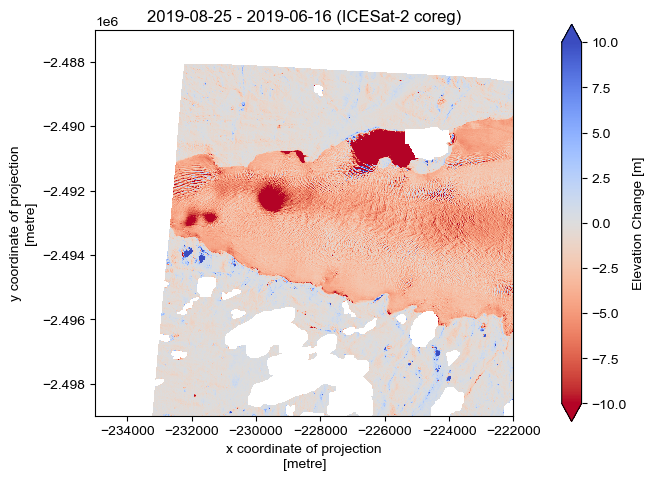
This provides a reasonable coregistration. The quality isn’t quite as high as the off-ice coregistration due to a lower number of points from dem_2. However, with higher numbers of coregistration points (>200), the quality can be on par with DEM-based coregistration. The risk of slightly lower quality coregistration based around non-optimal point quantity and distribution is offset by the ability to extend coregistration capabilities far from stable ground, into the ice sheet interiors.